

If I had to sum up 2026 in one line, it would be this: cultivated meat is moving closer to sale, but most UK shoppers still won’t see it in supermarkets this year.
What matters most now is simple:
- awareness is up
- trial is still limited
- restaurants will shape first impressions
- price will stay high
- hybrid products may come first
- FSA approval will matter a lot
- trust, safety and “is this too processed?” will affect demand
Put another way: 2026 looks like a testing year, not a mass-buying year. I’d expect early tastings, small launches, and lots of public debate about taste and texture challenges, cost, ethics, and how this meat is made.
2026 State of the Industry: Cultivated meat, seafood, and ingredients
sbb-itb-c323ed3
Quick Comparison
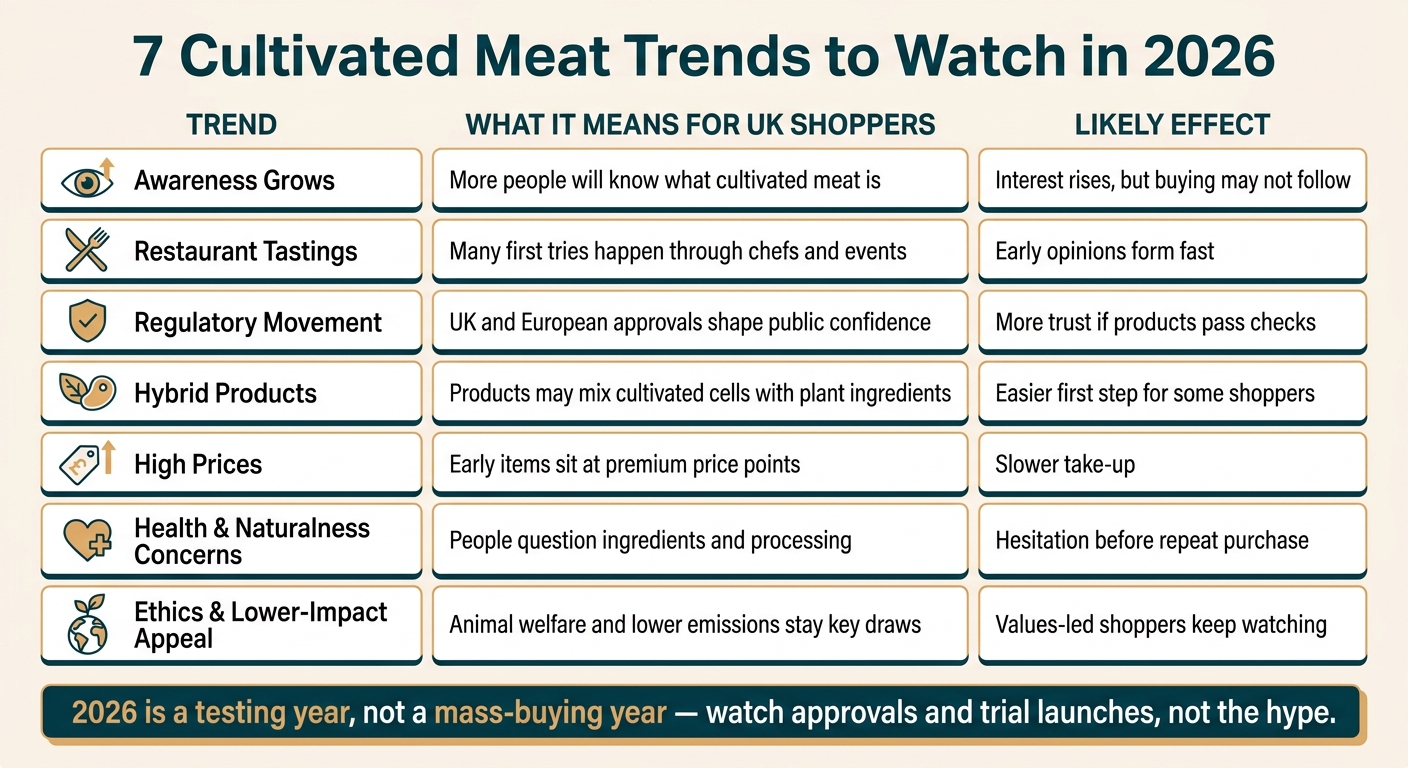
7 Cultivated Meat Trends Shaping the UK Market in 2026
| Trend | What it means for UK shoppers in 2026 | Likely effect |
|---|---|---|
| Awareness grows | More people will know what cultivated meat is | Interest goes up, but buying may not |
| Restaurant tastings | Many first tries may happen through chefs and events | Early opinions form fast |
| Regulatory movement | UK and European approvals shape public confidence | More trust if products pass checks |
| Hybrid products | Products may mix cultivated cells with plant ingredients | Easier first step for some people |
| High prices | Early items may sit at premium price points | Slower take-up |
| Health and naturalness concerns | People will question ingredients and processing | Hesitation before repeat purchase |
| Ethics and lower-impact appeal | Animal welfare and lower emissions stay key draws | Values-led shoppers keep watching |
For me, the main takeaway is clear: don’t watch the hype - watch approvals, trial launches, and whether people who taste it want to eat it again.
The 7 cultivated meat trends to watch in 2026
These trends show how curiosity is turning into cautious trial.
1. Awareness is growing, but willingness to try remains mixed
Awareness is set to grow in 2026, but willingness to try cultivated meat will still be split. More people may know what it is, yet that alone won’t be enough to get them to buy.
What will matter more? Trust and taste. If people don’t trust how it’s made, or don’t think it will taste good, awareness won’t go very far.
2. Restaurant tastings and limited launches are shaping first impressions
For a category that’s still new to many people, restaurant tastings and limited launches can have an outsized effect. They give shoppers a low-risk first taste, and that’s often where curiosity turns into trial.
A controlled setting helps too. If someone tries cultivated meat in a restaurant or through a small launch, the experience can feel more guided and less uncertain.
After those first tastes, approval and oversight will help decide whether interest keeps building.
3. UK and European regulatory progress is becoming part of the consumer story
Regulation will shape trust and availability in 2026. In the UK and across Europe, clearer approvals won’t just affect market access. They’ll also shape how people feel about the category.
For many shoppers, official approval sends a simple message: this product has been checked. That can support consumer confidence, especially in a category that still feels new.
4. Hybrid products could be the easiest first step for many shoppers
Hybrid products may offer the easiest first step for many shoppers. They can make the category feel less unfamiliar while still signalling something new.
That middle ground matters. For people who aren’t ready to jump straight into a fully cultivated product, a hybrid option may feel like a softer entry point.
5. Price will remain one of the biggest barriers to adoption
Price will remain a major barrier in 2026. Early products will likely stay premium, which means early interest is more likely to come from curious, values-driven shoppers who are willing to pay more.
That puts a clear limit on reach. Plenty of people may be interested in the idea, but far fewer will act if the price feels too high.
Even when the price feels acceptable, trust questions will still slow adoption.
6. Health, safety and naturalness concerns will shape buying decisions
Health, safety, ingredients and production method will all shape buying decisions. For many shoppers, the biggest hurdle isn’t just cost or access. It’s whether cultivated meat feels natural and familiar enough to eat.
That point is easy to miss. A product can sound safe on paper, but if it feels strange or overly processed, some people will still hold back.
7. Sustainability and ethical eating will keep driving interest
Sustainability and ethical eating are likely to remain major reasons people pay attention to Cultivated Meat. Much of its appeal comes down to animal welfare and lower environmental impact.
For some shoppers, that’s the hook. They may not be ready to buy straight away, but they’ll keep watching the category because it lines up with how they want to eat.
What these trends mean for UK shoppers
What to expect before cultivated meat reaches supermarkets
For UK shoppers, 2026 is about access, not supermarket choice.
So if you're expecting cultivated meat to show up in Tesco or Sainsbury’s during the weekly shop, that’s probably too soon. The Food Standards Agency (FSA) is speeding up approvals, but supermarket retail still looks more like a 2027 story at the earliest [3].
In the UK, first access is far more likely to come through chef-led restaurant tastings to see what cultivated meat tastes like than supermarket shelves. That means 2026 will probably look like this: restaurant launches first, followed by small retail or online trials.
Early products will almost certainly be hybrids. In plain terms, that means a mix of cultivated animal cells, often fat for flavour, with plant-based proteins. Companies are taking this route to help manage costs and improve texture [1] [2]. And yes, those first products are likely to stay premium-priced.
How to stay informed without the hype
As soon as early launches start, the big job is separating real progress from noisy marketing.
The simplest way to do that is to follow official FSA authorisations and actual launch announcements, rather than brand claims.
For consumer-focused updates on regulation, taste expectations, product formats and launch timing, Cultivated Meat Shop shares clear updates and early-access sign-ups.
Conclusion: Key cultivated meat trends to follow in 2026
These seven trends all point in the same direction: 2026 will build the market, not fill supermarket shelves.
What does that look like in plain terms? Awareness is going up, but people are still split on whether they want to try it. That makes first impressions a big deal. Early adoption will hinge on those first tasting moments, while hybrid products and premium pricing are set to shape the market in its early phase.
Regulation matters just as much. It will decide when people can move from hearing about Cultivated Meat to actually buying it. In the UK, the Food Standards Agency's current target suggests Cultivated Meat could go on sale by 2027 [3].
That puts pressure on early brands to get the message right. They need to present Cultivated Meat as sustainable, high-quality and appealing - not just new or unusual.
Access and price are only part of the picture. Consumer trust will play a huge role in what happens next. Health, transparency and concerns about processing will influence whether people buy again. Sustainability will stay a key reason for interest too, including the potential to cut emissions sharply compared with conventional beef [3].
So the thing to watch in 2026 isn't hype. It's approvals and actual product launches. This isn't the year of mass adoption. It's the year that will show whether the first products can earn trust.
FAQs
When will Cultivated Meat reach UK supermarkets?
Cultivated Meat isn’t on sale for human consumption in UK supermarkets yet. But things are moving. The Food Standards Agency is working on this through its regulatory sandbox programme.
The rollout is expected to happen in stages. That means these products will probably show up in selected restaurants before they reach shop shelves. If current timelines stay on track, the first products for humans could arrive on the UK market by March 2027.
For updates, you can follow Cultivated Meat Shop.
Why are hybrid products likely to launch first?
Hybrid products, which blend Cultivated Meat cells or fat with plant-based proteins, are likely to reach the market first. The reason is pretty simple: they can help cut costs and improve texture at the same time.
That gives manufacturers a practical way to deliver the familiar flavour and eating experience people expect from meat, while keeping prices more within reach as production scales. It also avoids the added complexity of tissue engineering needed to make whole cuts.
Will Cultivated Meat be affordable in 2026?
Not yet for the average consumer.
Even though production costs have dropped hard - from £250,000 per burger in 2013 to about £50–£100 per kilogram - it still costs more than regular meat.
To bring prices down, companies are scaling production, improving automation, switching to lower-cost food-grade growth media, and making hybrid products that blend cultivated meat with plant-based proteins.


