

Hybrid cultivated meat is cheaper to make, easier to produce at scale, and simpler to sell in familiar foods like burgers, sausages and mince. That is the short answer.
From what I can see, the article comes down to four plain points:
- Lower price: plant proteins such as soy, pea and wheat replace part of the cell-grown meat, which cuts the cost per kg.
- More portions from the same supply: using fewer cultivated cells per product means brands can stretch limited production across more packs.
- Better eating experience: small amounts of cultivated fat and muscle can improve flavour, juiciness and bite.
- An easier first try for shoppers: burgers, meatballs and sausages feel normal, so they are less of a jump for UK buyers.
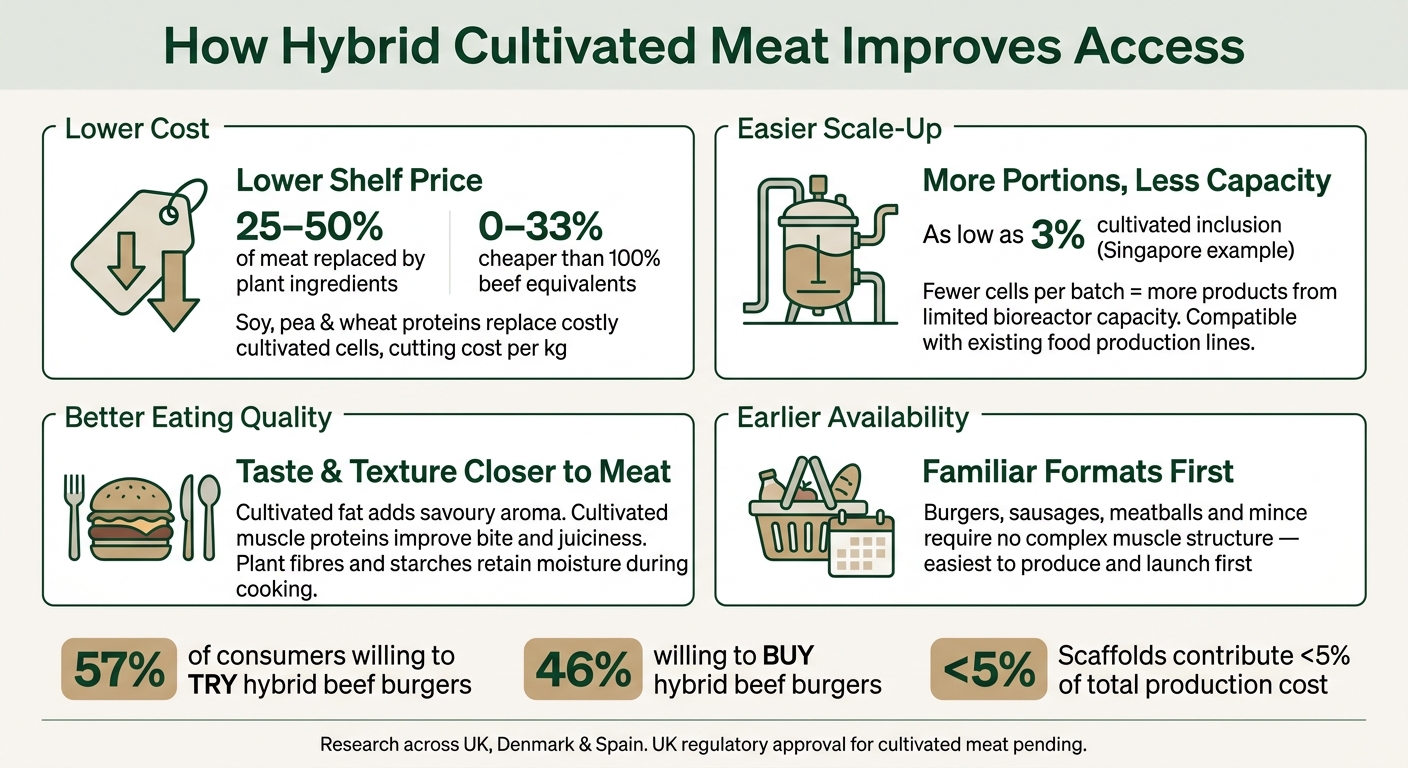
A few figures make this clear. In some blended meat products, 25–50% of the meat is replaced with plant ingredients, and prices were reported to be 0–33% lower than full-beef versions. Consumer research also found 57% were willing to try hybrid beef burgers, while 46% said they would buy them.
If I had to sum it up in one line, it would be this: hybrid products use a small share of cultivated meat where it matters most, and lower-cost ingredients everywhere else.
| Area | What helps access | What it means for UK shoppers |
|---|---|---|
| Price | Lower cultivated share | Lower shelf price potential |
| Production | Fewer cells needed per batch | More products can be made from limited capacity |
| Taste and texture | Cultivated fat and muscle in the mix | Food feels closer to meat people already know |
| Launch path | Familiar formats like mince and burgers | Easier first purchase and home cooking fit |
I’d treat hybrid cultivation as the first step, not the end point: it brings cultivated meat closer to everyday use by focusing on cost, scale, taste and familiar formats all at once.
Hybrid vs. Full Cultivated Meat: Cost, Scale & Consumer Appeal
Cost drivers of cultivated meat production
sbb-itb-c323ed3
Checklist: How plant ingredients help lower the price
Plant ingredients bring the price down by cutting the share of cultivated cells in the recipe. Put simply, if more of the product comes from lower-cost ingredients, the final cost per kilogram falls too.
Using lower-cost proteins to reduce the cultivated share
Soy, pea and wheat proteins are commodity ingredients made at scale, so their cost per kilogram is far below that of cultivated animal cells.[2][3] In a hybrid burger or sausage, these plant proteins can make up most of the bulk and much of the nutritional protein. The cultivated cells then do a more targeted job: adding the meaty flavour and aroma people expect.
This approach already has a clear retail parallel. Blended meat products in European retail replace 25–50% of meat with plant ingredients, and those products are reported to be 0–33% cheaper than their 100% beef equivalents at the same retailer.[5]
The main lever here is the share of the final product made from cultivated cells, often called the inclusion rate. A burger with a 30% inclusion rate is 30% Cultivated Meat and 70% plant ingredients, fats and seasonings. Bring that rate down, and the average ingredient cost per kilogram drops with it. For UK shoppers, that is the most direct path to a lower shelf price.
Adding structure with plant scaffolds and fillers
A scaffold is an edible support frame that gives cultivated cells shape and bite, so the product cooks and eats more like a burger or meatball. Without one, the cells form a loose mixture that is hard to shape.
Plant-derived scaffolds, made from materials such as textured soy protein (TVP), pea protein or cellulose, are low cost and already used in food production. Techno-economic analysis suggests scaffolds should contribute less than 5% of total production cost.[4]
Alongside scaffolds, plant-based fillers and binders such as starches, fibres and breadcrumbs help in a few practical ways:
- They improve water retention
- They help patties stay together during cooking
- They help create the juicy texture shoppers expect
All of that can be done without adding much cost.
Making affordable blends possible from the start
Even when cultivated cells make up only a modest part of the recipe, the product can still taste recognisably meaty. That matters because cultivated cells bring specific fat traits and aroma compounds that plant-only products often struggle to match.
When those cells are paired with neutral plant proteins and familiar seasoning profiles, such as the ones used in burgers, sausages and mince, the result is a convincing meat experience at a fraction of the cost of a 100% Cultivated Meat product. And there’s no mystery to the maths: a lower inclusion rate means a lower price point for the shopper.
Lower inclusion rates also mean fewer cultivated cells per batch, which makes hybrid products easier to scale.
Checklist: Why hybrid products are easier to scale and launch sooner
Needing fewer cultivated cells per batch
Lower ingredient cost also makes early production easier to scale.
Hybrid products combine Cultivated Meat cells with plant-based ingredients. So each burger or meatball uses a smaller share of cultivated cells than a fully cultivated whole cut. That means less demand on bioreactors and less strain on growth media.
There’s a simple knock-on effect here: when the cultivated share is lower, producers can use limited bioreactor designs and capacity across many more portions.
Working well in familiar formats such as burgers and meatballs
Burgers, meatballs, sausages and mince are the most practical formats to bring to market first.
Why? They don’t need aligned muscle fibres or detailed fat marbling. Instead, Cultivated Meat cells can be blended in more simply, while plant proteins provide most of the bulk and structure.
That makes these formats a good fit for early hybrid production. They need less complex structure than whole cuts, and they can be made through simple mixing and forming rather than trying to build muscle structure from the ground up.
Building on existing food production methods
Another plus with hybrid Cultivated Meat is that it can often be produced on existing food production lines.
Cultivated Meat cells can be used like a new ingredient within familiar mixing, forming and packaging stages. That cuts the need for bespoke equipment and makes it easier for established manufacturers to add hybrid products without starting from scratch.
That’s why hybrid products can reach the market sooner than whole-cut Cultivated Meat. In practice, hybrid burgers, meatballs and sausages are the most likely early products.
Checklist: How hybrid cultivation improves taste, texture and everyday appeal
Accessibility also comes down to one simple thing: will people want to buy it again? A lower price helps, of course. But that only goes so far if the product doesn’t taste right or cook in a way that feels familiar.
Bringing familiar meat flavour to blended products
Cultivated fat gives blended products the savoury smell and flavour that plant oils often struggle to deliver. Even a small amount can make a clear difference, helping cut plant-like aftertastes and bringing the flavour closer to what people expect from meat.
That flavour base also helps with texture and juiciness, so the product feels more like the real thing on the plate.
Balancing juiciness, bite and mouthfeel
Cultivated muscle proteins give hybrid products a firmer, more meat-like bite. Plant ingredients add bulk, while cultivated cells help improve bite and juiciness.
Fibres and starches help hold onto juices during cooking, which keeps the product succulent instead of dry. Different blend ratios also make sense for different meals. A lower-cultivation mix may work well for mince in sauces, while burgers and sausages may suit blends with more cultivated material.
Fitting easily into regular home cooking
This matters most when shoppers want something they can cook without changing their usual routine. Because cultivated fat renders during cooking, hybrid mince and patties can be seared to form a crust. The pan juices can then be used just as you would in everyday cooking, whether that’s building a bolognese or making a gravy.
UK developers have already shown hybrid pork mince in familiar British dishes such as sausages and scotch eggs. That shows how these products can slot into ordinary home cooking and makes them easier for UK shoppers to bring into day-to-day meals.
Checklist: What makes hybrid Cultivated Meat more accessible for UK shoppers
Once price, scale and taste get better, one big hurdle still remains: will UK shoppers pick it up and give it a go?
Introducing Cultivated Meat through familiar first products
For UK shoppers, familiarity makes a first try feel less like a leap. Hybrid Cultivated Meat is showing up in products people already buy, like burgers, sausages, meatballs and mince. That matters. When the format feels normal, the first purchase feels less risky.
Consumer research across the UK, Denmark and Spain found that 57% were willing to try hybrid beef burgers and 46% were willing to buy them [7][9]. That gives a useful early signal of demand while UK approval is still pending. Familiar product formats are doing much of the heavy lifting here.
Supporting broader choice as the category develops
That same familiarity can also help the category grow later on.
Lower inclusion rates make it easier for producers to expand the range over time. When less cultivated material is needed, companies can test more species, recipes and formats with lower technical risk.
In Singapore, hybrid Cultivated Meat products use around 3% cultivated chicken, with the rest plant-based [1][10]. That kind of cost-conscious design shows how the category may grow over time: starting with a small set of easy-entry products, then moving into more species, cuts and meal formats as production matures.
While UK approval for cultivated meat is still pending [6][8], launches abroad offer a useful preview of the product types and routes to market that may later shape what reaches UK shelves.
Conclusion: The main reasons hybrid cultivation improves access
Taken together, hybrid Cultivated Meat can improve access for UK consumers in four main ways:
- Lower cost - plant ingredients reduce the cultivated share.
- Easier scale-up - fewer cells per batch reduce complexity.
- Better eating quality - cultivated fat and muscle improve flavour and bite.
- Earlier availability - familiar formats are the most likely first products.
FAQs
What is hybrid Cultivated Meat?
Hybrid Cultivated Meat blends cultivated animal cells with plant-based ingredients. The goal is simple: make it cheaper and faster to produce than fully cultivated meat.
Ingredients from plants, such as soy, wheat, rice bran, and textured vegetable protein, help support cell growth while cutting dependence on expensive biomass. That can bring down production costs for products like burgers and nuggets.
Will hybrid products taste like normal meat?
Yes. Hybrid products are made to match the taste, texture and overall eating experience of meat by blending cultivated animal cells with plant-based proteins.
Sensory tests show they do this well, and many people find them hard to tell apart from conventional meat. Cultivated Meat Shop offers more detail on how this approach can improve access without compromising on taste.
When could hybrid Cultivated Meat reach UK shops?
There’s no fixed launch date yet. But based on the progress of UK regulation, the first Cultivated Meat products could reach the market as early as March 2027.
The first products are likely to be Hybrid Cultivated Meat. These combine animal cells with plant-based proteins, which can make the path to market a bit easier.
The rollout probably won’t start in supermarkets. It’s more likely to begin in selected restaurants, with shop shelves coming later.


