

- Better Cell Lines: Engineering cells to grow faster, use less expensive nutrients, and produce their own growth factors.
- Plant-Based Growth Factors: Replacing costly animal-derived components with plant-based alternatives like hydrolysates or algae extracts.
- Hybrid Products: Mixing cultivated cells with plant proteins to lower costs without sacrificing flavour.
- Improved Bioprocesses: Using advanced bioreactors and continuous production methods to grow cells more efficiently.
- Scaling Up Production: Building cheaper, large-scale systems that operate continuously to cut down costs.
These strategies are helping push prices closer to conventional meat, with some companies already achieving cost parity with organic options. The goal is to make cultivated meat accessible while reducing resource use like land and water. Keep reading for a detailed breakdown of each approach.
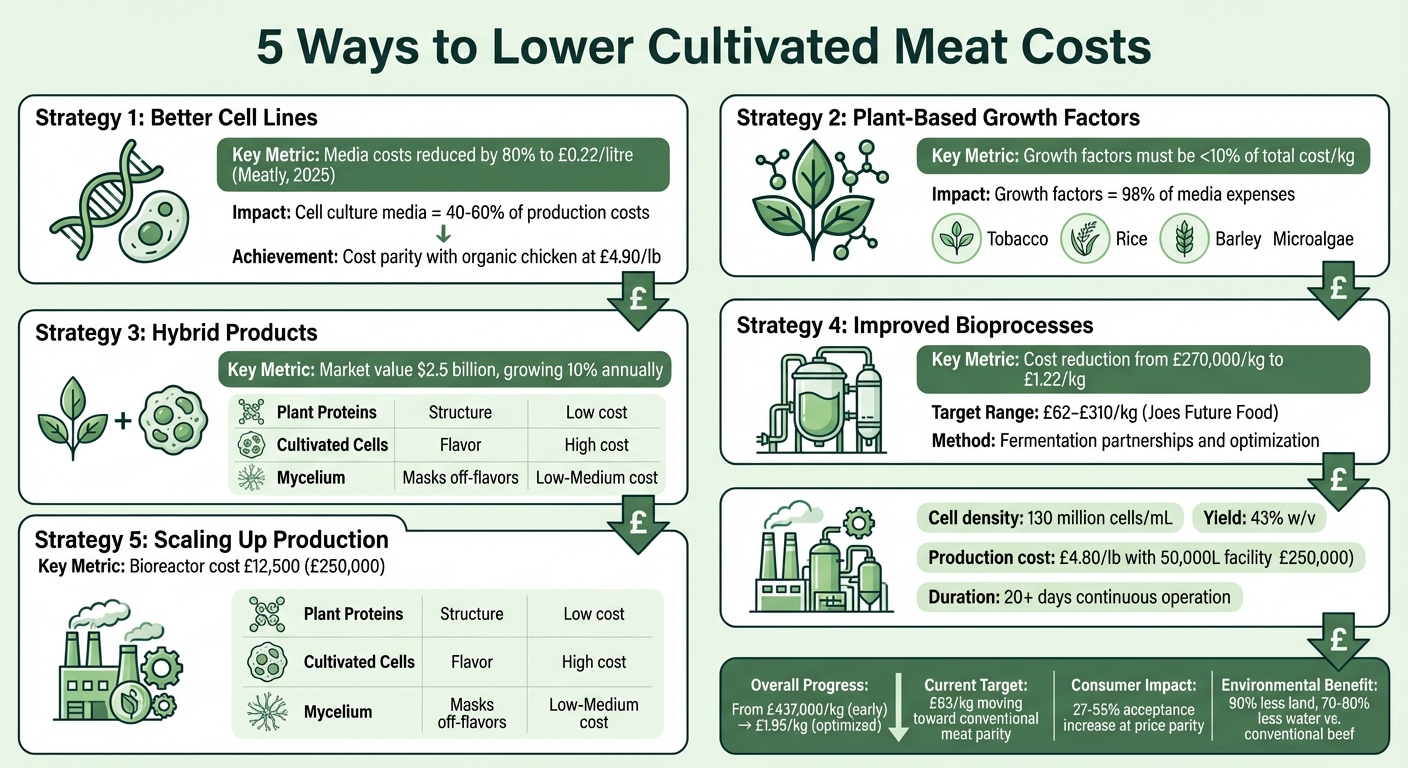
5 Strategies to Reduce Cultivated Meat Production Costs
Cost drivers of cultivated meat production
sbb-itb-c323ed3
1. Improve Cell Lines for Better Growth and Media Efficiency
One way to bring down production costs is by engineering cell lines to rely on less expensive inputs. This can involve enabling cell lines to produce their own growth factors, grow in simpler media, and achieve higher cell densities - all of which contribute to more cost-effective production.
Cost Reduction Potential
Cell culture media represents a significant portion of production costs - between 40% and 60% - and growth factors alone can make up as much as 98% of those expenses [2][1]. By engineering cell lines to synthesise their own growth factors, companies can eliminate the need for costly external additives. For example, researchers at Tufts University have patented cell lines that can grow in minimal media by internally producing two or more growth factors [1].
Another cost-saving measure involves replacing expensive components like albumin with alternatives such as methylcellulose and hydroxypropyl β-cyclodextrin. This approach has already lowered costs to approximately £4.90 per pound for cultivated chicken [2]. A study published in Nature Food in August 2024 by researchers including L. Pasitka and Professor Yaakov Nahmias, funded in part by Believer Meats, demonstrated that this method achieves cost parity with organic chicken [2].
These innovations pave the way for further advances in increasing cell density and improving process efficiency.
Technical Progress
Tangential Flow Filtration (TFF) in perfusion bioreactor designs has been a game-changer, allowing researchers to achieve a cell density of 130 billion cells per litre - far beyond what traditional methods can accomplish [2]. This continuous production system operates for up to 20 days without interruption, efficiently removing waste and maintaining stability throughout the cycle [2].
In May 2025, the UK-based company Meatly made a significant breakthrough by reducing medium costs by 80%, bringing them down to just £0.22 per litre. At industrial scales, projections suggest costs as low as 1.5p per litre. Meatly’s patented medium supports 175 cell doublings without requiring steroids, antibiotics, or hormones, marking a major step forward in both cost reduction and scalability [3].
Regulatory Feasibility
While these technical achievements are promising, regulatory considerations remain critical. Genetic modification of cell lines offers significant cost reductions but can face scrutiny in markets wary of GMOs. To address these challenges, researchers are exploring reversible genetic modifications, such as the Cre-loxP system, which allows foreign material to be removed after cell expansion [1].
In July 2024, Meatly secured regulatory approval from UK authorities for cultivated pet food, demonstrating that regulatory systems are evolving to accommodate these innovations. This approval highlights the UK’s growing support for cultivated products, helping to make Cultivated Meat more accessible and affordable [1].
2. Create Plant-Derived Growth Factors and Proteins
Advances in cell line development are being complemented by plant-based alternatives that reduce dependence on expensive animal-derived inputs. Replacing these components with plant-based options offers a way to significantly cut production costs. Traditional cell culture methods often rely on Fetal Bovine Serum (FBS), which is both expensive and inconsistent [4].
Cost Reduction Potential
Keeping costs under control is critical for commercial success, and plant-derived solutions are stepping up to meet this need. Plant-based hydrolysates are proving to be affordable, food-grade substitutes that address both cost efficiency and reproducibility. This move not only reduces expenses but also opens the door to new production techniques.
The combined cost of recombinant GFs and SPs must remain below 10% of the total cost per kilogram of meat to ensure commercial viability, as noted by the Good Food Institute [4].
Technical Progress
To meet these strict cost targets, two key approaches are gaining traction. Molecular farming - where DNA is inserted into host plants like tobacco, rice, barley, and oilseed - shows promise as a scalable solution. Similarly, nutrient delivery systems using extracts from microalgae species such as Chlorella vulgaris, Chlorococcum littorale, and Auxenochlorella pyrenoidosa offer exciting possibilities for cost-effective production [5].
Regulatory Feasibility
Switching to food-grade, plant-derived components aligns well with evolving regulatory requirements. Using non-animal sources not only upholds the ethical advantages of Cultivated Meat but also ensures the consistency needed to meet regulatory standards [4]. For example, while fusion tags are often removed to maintain protein bioactivity and preserve their native form, it’s crucial they don’t interfere with functionality [4]. Despite these advancements, the widespread adoption of plant-based alternatives within the industry remains a work in progress [4].
3. Use Hybrid Products with Plant-Based Components
Cutting production costs is key to making cultivated meat more affordable and widely available. Hybrid products - combining cultivated cells with plant proteins - offer a cost-effective solution without sacrificing the authentic taste of meat.
Cost Reduction Potential
The approach is straightforward: plant proteins, which are relatively inexpensive, provide the texture, while the pricier cultivated cells are used to deliver the flavour. Research indicates that even undifferentiated cells, such as avian fibroblasts, can significantly enhance the taste of plant-based protein bases without requiring costly processes to develop them into mature muscle tissue [7].
"Blending - and therefore diluting - cultured animal cells with plant-based substrates enables larger-scale introduction at relatively low prices."
– Mark J. Post, Co-founder and CSO, Mosa Meat B.V. [7]
The hybrid meat market, which includes combinations of conventional meat and plant-based ingredients, is currently valued at $2.5 billion globally and is expected to grow by 10% annually [6]. This blending strategy not only lowers costs, improves nutrient recovery, and simplifies scaling up production.
Scalability for Mass Production
Beyond cost savings, hybrid products benefit from the well-established processes used in plant-protein production. This makes scaling up much simpler compared to pure cultivated meat. For example, in January 2023, Singapore's Food Agency approved GOOD Meat's serum-free cultivated chicken as a hybrid product for commercial production. Similarly, in January 2024, Israel's Ministry of Health approved Aleph Farms' serum-free cultivated beef, which was also launched as a hybrid to ensure it remained affordable and texturally satisfying [1].
Plant-based components play a crucial role in providing the fibrous structure that cultivated cells alone struggle to achieve at scale. Meanwhile, the cultivated cells deliver the distinctive flavour of meat. To fine-tune these combinations, companies are increasingly relying on AI tools that predict the best mix of plant proteins and cultivated cells, addressing challenges in flavour chemistry and texture [7].
Technical Progress
Undifferentiated cells are particularly effective in ground or blended products, offering meat-like flavour at a much lower cost. Projects like PLENITUDE are pushing the boundaries of hybrid products by integrating plant proteins for structure, mycelium for added nutrition (and to mask any plant off-notes), and cultivated cells for aroma [7].
| Component | Primary Function | Production Cost |
|---|---|---|
| Plant Proteins | Structure and texture | Low |
| Cultivated Cells | Flavour and aroma | High |
| Mycelium | Masks plant off-flavours | Low to Medium |
This combination balances cost and quality, leveraging plant proteins for structure and cultivated cells for flavour, creating a more accessible and scalable solution for cultivated meat production.
4. Improve Bioprocesses Through Partnerships and Fermentation
Cutting Costs with Innovation
Recent strides in fermentation technology and supplier collaborations are driving down production costs significantly. For example, an optimised bioreactor system has slashed costs from a staggering £270,000/kg to just £1.22/kg. This dramatic reduction could make cultivated meat a realistic competitor to traditional meat options [8]. Similarly, Joes Future Food is working closely with suppliers of growth medium raw materials to establish industry benchmarks, aiming for production costs between £62 and £310 per kilogramme [9]. These collaborations allow companies to pool their knowledge in areas like media optimisation and bioreactor design. Such advancements in fermentation are building on earlier progress in cell line engineering and media development.
Scaling Up Production
With costs coming down, the focus now shifts to scaling up production. Modern continuous processing techniques are proving to be game-changers compared to traditional batch systems, enabling higher cell densities and greater yields [8]. A great example is IntegriCulture, a Japanese startup with plans to achieve self-sustaining profitability by 2028 [9]. Using dynamic bioreactor controls, they ensure optimal conditions for cultivating high-density cell cultures [8].
These advancements in bioprocesses are essential for lowering production costs further and making cultivated meat more competitive in the market.
Progress Through Collaboration
Continuous improvements in media optimisation, yield enhancement, and process refinement are adding up to significant progress [10]. Companies like Mission Barns are showing how partnerships can accelerate these advancements. By focusing on scaling up the production of cultivated fat for hybrid products, they highlight the power of collaboration in driving technical development [9].
5. Design for Scale with Continuous Processing and Higher Yields
Advances in bioprocessing have made continuous processing a game-changer for cutting production costs and boosting efficiency.
Cost Reduction Potential
Continuous manufacturing slashes production expenses by a significant margin. In August 2024, researchers from the Hebrew University of Jerusalem and Believer Meats showcased a continuous process utilising Tangential Flow Filtration (TFF). This method achieved biomass densities of 130 million cells/mL and a 43% w/v yield. By using an animal-component-free medium priced at just £0.47 per litre, their analysis found that a 50,000-litre facility could produce cultivated chicken at a cost of £4.80 per pound ($6.20/lb) [11].
"The cost of cultivated chicken can drop to within the range of organic chicken at US$6.2 lb−1 by using perfusion technology." - Nature Food [11]
In the UK, Meatly has developed a patented 320-litre bioreactor priced at £12,500, which represents a 95% cost reduction compared to traditional biopharma-grade vessels that typically cost £250,000 [3]. Helder Cruz, Meatly's CSO, explained:
"At Meatly, we have worked tirelessly with the team to bring to reality both our new low-cost bioreactor, as well as a record cheap medium to be used within it" [3].
These advancements are driving down costs while enabling higher-yield production.
Scalability for Mass Production
Continuous systems allow for multiple harvests over 20+ days, which maximises the use of bioreactors and cuts down on downtime [11]. Unlike traditional batch methods, which require complete shutdowns for cleaning after each cycle, continuous operations keep production running smoothly. The transition from costly pharmaceutical-grade equipment to purpose-built industrial designs has made large-scale production more financially feasible [3].
Technical Progress
Continuous processing also supports cell densities far higher than those achieved with batch methods, with biomass yields reaching 43% w/v [11]. Innovations like low-shear magnetic levitation pumps and specialised cell-retention devices maintain cell viability even during high-density runs [11]. Additionally, advanced media formulations now enable up to 175 cell doublings without the need for steroids, antibiotics, or growth factors [3].
Conclusion
The cost of cultivated meat is steadily decreasing, thanks to five main strategies: advancements in cell lines, plant-based growth factors, hybrid products, bioprocess improvements, and continuous manufacturing. These efforts are pushing prices down from the current £63/kg, aiming to match conventional meat. Back in 2020, Risner et al. highlighted the potential of these combined strategies, slashing costs from £437,000/kg to £1.95/kg by improving cell densities, shortening doubling times, and enhancing bioreactor efficiency [8].
Collaboration within the industry is playing a crucial role in turning these breakthroughs into practical solutions. Companies like Joes Future Food are working to standardise growth media, targeting costs of £0.99 to £4.95 per kilogramme, while IntegriCulture is aiming for profitability by 2028 [9]. These partnerships are speeding up progress by pooling knowledge and resources. Studies also suggest that consumer acceptance could increase by 27-55% once cultivated meat prices match or fall below those of traditional meat [8]. Such teamwork is essential for the transition from experimental production to commercial success.
The year 2026 is shaping up to be pivotal for the industry, as the focus shifts from hype to tangible, evidence-based progress. Hybrid products are proving their scalability, moving beyond the experimental stage into real-world production [10]. With cultivated meat requiring up to 90% less land and 70-80% less water compared to conventional beef [12], the economic and environmental benefits are becoming increasingly aligned.
As these advancements continue, staying informed is key. Platforms like Cultivated Meat Shop are helping consumers navigate this new category by offering accessible information on the science behind cultivated meat, sustainability, and product options. Through clear content and waitlist sign-ups, they are building interest and trust, preparing the British market for the arrival of cultivated meat and helping consumers feel confident about this innovative food option.
FAQs
Why is cultivated meat so expensive today?
Cultivated meat is still expensive, and a big part of the cost comes from cell culture media, which can account for a staggering 55–95% of production expenses. Within this, growth factors - critical for cell development - are especially pricey, often reaching thousands of pounds per gram. On top of that, producing cultivated meat requires specialised equipment, such as bioreactors and clean-room facilities, demanding substantial financial investment. Although progress is being made to bring costs down, the combination of expensive raw materials and production processes means prices remain higher than traditional meat.
Are genetically engineered cell lines likely to be approved in the UK?
Genetically engineered cell lines are expected to receive approval in the UK. The UK Food Standards Agency is working on developing regulations and safety assessments tailored to cultivated meat products, including those produced from animal cells. These steps highlight an increasing emphasis on ensuring that cultivated meat complies with safety and regulatory requirements, paving the way for its potential introduction to the market.
When will cultivated meat reach the same price as conventional meat?
Cultivated meat is projected to match the price of conventional meat by approximately 2030. Estimates indicate it might cost as little as £4.30 per kilogramme by then, driven by continuous improvements in production methods and innovative cost-reduction strategies.


