

Cultivated meat is now priced to compete with premium chicken. Israeli startup SuperMeat has achieved a cost of £10.20 per pound (around $13 USD) for 100% cultivated chicken. This brings it closer to supermarket shelves in the UK, offering a product grown from animal cells without slaughtering animals. Here's what you need to know:
- Price: At £9.25–£10.20 per pound, cultivated chicken rivals premium free-range options (£6.70–£8.65) but remains pricier than standard chicken (£2.75–£3.95).
- Production: Cultivated meat uses 80% less land and takes just 2 days to produce 3 pounds of chicken, compared to 42 days for conventional poultry farming.
- Market Outlook: While not yet available in UK supermarkets, cultivated chicken is positioned as an alternative for eco-conscious consumers. Platforms like Cultivated Meat Shop are helping to educate shoppers.
Although cultivated meat costs more than standard chicken, its reduced impact on resources and potential for scalability could make it a competitive option in the future.
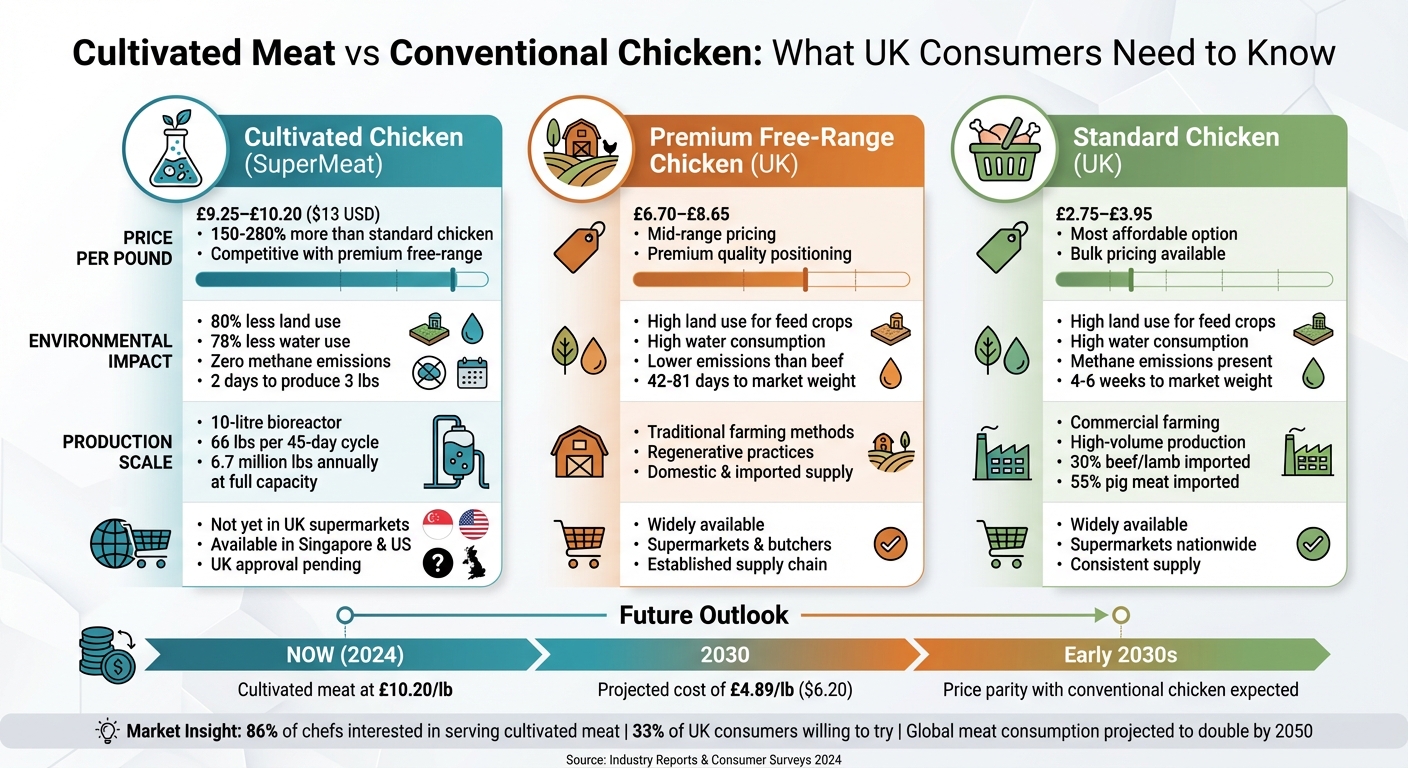
Cultivated Meat vs Conventional Chicken: Price, Environmental Impact & Production Comparison
1. SuperMeat's Cultivated Chicken
Price
In November 2024, the Israeli biotech company SuperMeat announced a significant milestone: achieving a cost of £9.25 per pound for cultivated chicken. This is notably below the broader industry estimate of $13 per pound (around £10.20). The product, grown directly from animal cells, mirrors the composition of conventional chicken, marking a major step forward for the cultivated meat industry.
The reduced cost is largely thanks to advancements in production methods. SuperMeat has managed to lower the cost of cell feed to under £0.39 per litre (less than $0.50) by replacing expensive animal-based components with plant-based alternatives. Their continuous production system also plays a key role - using a compact 10-litre bioreactor, the company can produce 30 kg (66 pounds) of cultivated chicken in a 45-day cycle. This efficiency not only cuts costs but also makes the product more competitive for the UK market.
Affordability for UK Consumers
At £9.25 per pound, SuperMeat's cultivated chicken is priced to compete with premium pasture-raised chicken available in some UK markets. This positions it as a high-quality alternative to traditionally farmed options. By comparison, Good Meat's cultivated chicken in Singapore costs over £15.70 per pound (more than $20 USD) and contains just 3% cultivated cells blended with plant-based ingredients.
SuperMeat’s CEO, Ido Savir, highlighted the commercial potential of their product:
We see a tremendous opportunity for affordable cultivated chicken meat that supplies the same delicious taste and nutrition as premium chicken, which is a path for consumer and market acceptance and long-term adoption.
This price point could make cultivated chicken a viable choice for UK households, appearing alongside organic and free-range options in supermarkets. What was once a niche product for early adopters could soon become a mainstream option for British shoppers.
Environmental Impact
SuperMeat’s production method is a game-changer for sustainability. It uses 80% less land than traditional farming, thanks to its compact bioreactor system, which eliminates the need for sprawling agricultural infrastructure. At full industrial scale, a single facility could produce 3 million kg (6.7 million pounds) of chicken annually - equivalent to the output of 2.7 million conventionally raised chickens.
The production process is remarkably efficient. Once continuous production begins, SuperMeat can produce three pounds of meat in just two days. Fat tissue matures in just 24 hours, while muscle tissue takes four days to develop. This rapid production timeline, combined with the reduced land use, offers a practical solution for sustainability-conscious UK consumers who don’t want to compromise on taste or nutritional value.
These environmental benefits further enhance the appeal of cultivated chicken, making it a compelling alternative to traditional poultry.
Production Scale and Market Outlook
SuperMeat’s technology demonstrates impressive scalability. At full capacity, a single production facility could churn out 6.7 million pounds of chicken annually, highlighting the commercial viability of cultivated meat. This scalability ensures that both environmental and economic benefits can be passed on to consumers. Addressing doubts about the industry, Ido Savir stated:
Current sentiment around cultivated meat includes skepticism regarding its scalability and market readiness... Our new report provides proof that with the right technology, there is a commercially viable path to market.
Although cultivated chicken hasn’t yet reached UK supermarkets, the £9.25 per pound price point suggests it could soon be available as a competitive premium option. A survey by the company revealed that 86% of chefs are interested in serving cultivated meat, though 64% of US consumers remain unfamiliar with the technology. This highlights the importance of platforms like Cultivated Meat Shop in educating British shoppers about this emerging category.
2. Conventional UK Chicken (Premium and Standard)
Price
When compared to the higher cost of cultivated meat, conventional UK chicken offers a range of pricing options based on quality and purchase size. Standard chicken breast fillets from butchers are priced at about £3.63 per pound when purchased in bulk (5kg trays). Smaller retail packs of 800g, however, cost approximately £4.53 per pound. For those seeking premium free-range chicken, such as slow-grown options from suppliers like Swaledale Butchers, prices range between £4.17 and £6.67 per pound, depending on the pack size. Individual premium chicken breasts, weighing between 170g and 200g, can cost as much as £6.67 per pound at retail.
In comparison, cultivated meat currently costs 150%–280% more than conventional chicken, depending on whether consumers buy in bulk or opt for individual portions.
Affordability for UK Consumers
While about 33% of UK consumers are open to trying cultivated meat, its widespread adoption hinges on achieving price parity with traditional options. For now, cultivated meat producers are focusing on "innovators" and "early adopters", a group that makes up around 16% of the market and tends to be less price-sensitive. The remaining 68%, representing the early and late majority, are likely to wait until prices align with conventional chicken before making the switch.
Khaled Tawfik from Boston Consulting Group explains the timeline for this shift:
It will take time for cultivated meat to become economically viable... We estimate that it will reach price parity with traditional meat sometime in the early 2030s [3].
Beyond pricing, factors like environmental and production practices continue to shape the market for conventional chicken.
Environmental Impact
The environmental impact of conventional chicken production is increasingly under the spotlight. Standard commercial chickens are raised to market weight in just 4–6 weeks, while premium slow-grown birds require up to 81 days. Both systems rely heavily on land-intensive feed production, which contributes to their environmental footprint.
Suppliers like Swaledale Butchers focus on "regenerative practices" and "traditional farming" to attract ethically conscious consumers - the same segment targeted by cultivated meat producers [1]. However, even with these improvements, conventional chicken production cannot compete with the potential land use efficiency of cultivated meat, which could require 95% less land when powered by renewable energy [3].
Production Scale and Market Outlook
While conventional chicken remains the more affordable option, its large-scale production and reliance on imports pose challenges. Despite the UK's significant domestic production, 30% of beef and lamb and 55% of pig meat are imported, leaving the market vulnerable to global price fluctuations [3]. Standard commercial chicken production dominates the market, with birds reaching slaughter weight in just 4–6 weeks, ensuring a steady supply to meet demand.
As global meat consumption continues to climb - projected to double by 2050 [2] - the industry faces increasing pressure on both pricing and sustainability. Supermarket pricing strategies often strain producers and grain farmers, adding to these challenges. Although conventional chicken currently holds a strong cost advantage, the growing advancements in cultivated meat technology raise the question of when, not if, UK consumers will view it as a practical and accessible alternative rather than a premium choice.
Cost drivers of cultivated meat production
sbb-itb-c323ed3
Pros and Cons
Choosing between Cultivated Meat at £10.25 per pound (around £22.60 per kg) and conventional UK chicken comes down to weighing cost, environmental benefits, and availability. Here's a quick comparison:
| Feature | Cultivated Meat (£10.25/lb) | Premium Conventional Chicken (UK) | Standard Conventional Chicken (UK) |
|---|---|---|---|
| Price per lb | £10.25 | £6.70–£8.65 | £2.75–£3.95 |
| Environmental Impact | Uses up to 78% less water, no methane emissions, low land use [4] | High land and water use; lower emissions than beef | High land and water use; dependent on feed crops |
| Consumer Access | Limited (available in Singapore and the US; UK approval pending) [4][5] | Easily available in supermarkets and butchers | Widely available |
Cultivated Meat stands out for its environmental benefits. Dr Simon Eassom of Food Frontier highlights this advantage:
Cultivated Meat has zero methane production. Ruminating animals belch methane and, as we know, methane emissions are more damaging than CO₂ from fossil fuels [4].
Despite these benefits, the cost remains a significant hurdle. At £10.25 per pound, Cultivated Meat is much pricier than both premium and standard conventional chicken. However, as production scales, this gap may shrink. For example, French startup Gourmey has projected a potential production cost of €7 per kg in the future [5].
Availability is another challenge. Currently, Cultivated Meat is only sold in Singapore and the US, with UK regulatory approval still in progress. Meanwhile, conventional chicken is a staple in supermarkets and butcher shops across the UK.
For those interested, UK consumers can stay informed or join waitlists through platforms like Cultivated Meat Shop. As production costs drop, the decision may eventually shift from being about affordability to simply personal preference.
Conclusion
At approximately £10.20 per pound (around £22.46 per kg), Cultivated Meat is currently positioned as a premium option for UK consumers. While it costs more than standard chicken, it aligns with the price of high-end organic products, appealing to those prioritising sustainability and animal welfare. Research from Believer Meats suggests that with ongoing advancements in manufacturing, costs could drop to about £4.89 per pound (roughly $6.20) by 2030, making it a far more budget-friendly option [6].
This potential price reduction could significantly increase accessibility while relieving pressure on the UK food system. With domestic poultry valued at around £10 billion annually and reliant on imports of approximately 1 million tonnes, Cultivated Meat offers a slaughter-free alternative that aligns with the UK's net-zero ambitions. As production becomes more efficient, this innovation could strengthen the resilience of the UK's food supply chain [6][7].
During this period of change, providing consumers with clear and reliable information is crucial. This is where Cultivated Meat Shop steps in, offering product previews, waitlist opportunities, and easy-to-understand content to guide households through this shift. Their resources help demystify the process, making the idea of sustainable meat more approachable and practical.
As prices fall and production expands, UK consumers could soon find that Cultivated Meat is not only a sustainable option but also an accessible one worth exploring.
FAQs
When will cultivated meat be sold in UK supermarkets?
Cultivated meat is expected to hit UK supermarket shelves by 2027, as progress continues in securing regulatory approvals. This timeline highlights the focus on ensuring these products meet safety and quality standards before becoming accessible to the public.
Is cultivated meat safe to eat and regulated in the UK?
Cultivated meat is safe to eat and is regulated in the UK. Both the Food Standards Agency (FSA) and Food Standards Scotland (FSS) have issued safety guidance, confirming that these products fall under existing food safety regulations. This means cultivated meat must meet the same rigorous standards as other foods before it is made available to consumers.
Will Cultivated Meat ever be as cheap as standard chicken?
Cultivated meat is edging closer to matching the price of conventional chicken. Some producers have already managed to bring costs down to approximately £9 per kilogram when produced at scale, which is similar to the price of premium pasture-raised chicken. As production methods continue to improve, further cost reductions are anticipated, making cultivated meat a more accessible option for consumers over time.


