

Producing meat uses a huge amount of water, much of which goes into growing feed for animals. For example:
- Beef: ~15,415 litres per kilogramme
- Pork: ~6,000 litres per kilogramme
- Chicken: ~4,300 litres per kilogramme
In comparison, Cultivated Meat (grown from animal cells) requires only about 3,100 litres per kilogramme - up to 78% less water than beef. This is because it skips water-intensive steps like rearing animals and growing feed crops.
Meat production relies on three types of water:
- Green water (rainfall stored in soil)
- Blue water (from rivers, lakes, and aquifers)
- Grey water (to dilute pollutants).
Beef is the most water-intensive meat due to its feed requirements and slow growth. Pork and chicken use less water thanks to more efficient feed conversion and shorter rearing cycles.
Switching to meats like chicken or pork, reducing food waste, or considering Cultivated Meat are practical ways to lower your water footprint. In the UK, beef relies heavily on rain-fed pastures, which reduces its blue water use compared to other regions.
Cultivated Meat offers a promising solution, using far less water than conventional meats. While not yet available in UK supermarkets, platforms like Cultivated Meat Shop provide resources and waitlists for those interested in trying this option in the future.
Understanding the 'water footprint' of beef
Understanding Water Footprint in Food Production
The water footprint of a product represents the total volume of freshwater used throughout its production process, from start to finish. In the case of meat production - spanning everything from growing animal feed to processing - agriculture is responsible for a staggering 70–92% of global freshwater withdrawals [3].
However, not all water usage has the same environmental impact. For instance, withdrawing blue water in areas facing water scarcity has far more serious consequences than relying on green water, which comes from rainfall, in wetter regions like much of the UK. This distinction highlights why understanding the different types of water footprints is so important when evaluating the environmental impact of your meat choices.
The 3 Types of Water Footprint
Water footprints are divided into three categories: green, blue, and grey water [3].
Green water refers to rainfall stored in the soil and absorbed by plants. It accounts for the majority of water used in meat production: over 90% of beef’s water footprint, 73% for pork, and 79% for poultry [2]. Since green water is naturally replenished through rainfall, its environmental impact is generally lower, especially in rainy areas like the UK, where irrigation is less common.
Blue water comes from surface and groundwater sources, such as rivers, lakes, and aquifers. This type of water is used for irrigation, animal drinking, and processing. Excessive blue water withdrawals can deplete freshwater reserves. For example, producing 1 kilogramme of beef requires around 50 litres of blue water, while pork needs 450 litres and chicken 300 litres [2]. In the UK, where grazing relies heavily on rain-fed grasslands rather than irrigation, producing 1 kilogramme of beef carcass uses an average of 67 litres of blue water [8].
Grey water measures the volume of freshwater needed to dilute pollutants - such as fertiliser runoff, pesticides, and manure - to meet acceptable water quality standards. When green water is excluded, the combined blue and grey water usage for beef production ranges between 550–700 litres per kilogramme [2].
Why Water Usage Affects the Environment
High water footprints place immense strain on the planet’s freshwater resources. Livestock production alone accounts for 8–13% of global blue and grey water usage, exacerbating issues like water depletion, salinisation, and competition with human water needs [3]. In the United States, livestock consumed an astonishing 72,650 billion gallons of water annually between 2014 and 2016, with 99% of this water allocated to growing animal feed [7]. Such levels of consumption also contribute to soil degradation and put further pressure on freshwater systems already under stress from climate change.
For consumers in the UK, where water stress is becoming a growing concern, opting for meats with lower water footprints - or considering Cultivated Meat - can help reduce the demand on limited freshwater resources. By focusing on blue and grey water figures rather than including plentiful green rainwater, it’s easier to gauge the real environmental impact of meat production. This understanding is crucial when comparing the resource demands of conventional meat to the water savings offered by Cultivated Meat.
Water Requirements for Traditional Meat
Let’s dive into how traditional meat production uses water, focusing on the significant demands it places on resources.
A substantial portion of water in traditional meat systems is used to grow animal feed. Between 2014 and 2016, livestock in the United States consumed a staggering 72,650 billion gallons of water annually, with 99% of that water dedicated to feed production [7]. This trend isn’t unique to the US - globally, feed production accounts for around 85–99% of total water use in livestock systems [7][4][10].
On average, producing 1 kilogramme of beef requires 15,415 litres of water, while pork and chicken need 6,000 litres and 4,300 litres, respectively [3]. These numbers reflect the combined use of green, blue, and grey water across all stages of production, with feed cultivation being the primary contributor.
Beef: The Heavyweight in Water Use
Beef production is by far the most water-intensive among meats. Estimates suggest that producing just 1 pound of beef demands 1,850 gallons of water - that’s about 8,400 litres [5]. Even when excluding rainfall and focusing on blue and grey water (more sensitive to environmental pressures), beef still requires 550–700 litres per kilogramme [2].
Why is beef so water-intensive? It comes down to the way cattle convert feed into meat. Cattle have a low feed conversion efficiency - only 3–6% of the energy from their feed becomes meat. Add to that their slow growth rate of 18–24 months, and it’s clear why they need vast amounts of forage and water [2][4][5]. In the US, 84% of beef’s water use is tied to growing forage, pastures, and crop by-products [7]. Beef cattle alone account for nearly half of all livestock-related water consumption in the country [7].
The picture is somewhat different in the UK, where beef is mostly grass-fed on rain-fed pastures. This drastically reduces its blue water footprint to about 67 litres per kilogramme of beef carcass, or 33 litres for a 375-gramme serving of English topside [8]. By comparison, beef systems in parts of the US that rely on irrigated feed can consume up to 2,000 litres of blue water per kilogramme, drawing heavily from rivers and aquifers [8].
While beef dominates water use, pork and chicken offer a less resource-heavy alternative.
Pork and Chicken: Lower Water Demands
Pork and chicken require considerably less water than beef, though their production still consumes notable amounts. Producing 1 kilogramme of pork uses around 6,000 litres of water, while chicken needs approximately 4,300 litres [3]. When focusing on blue and grey water, pork uses about 450 litres per kilogramme, and chicken requires just 300 litres [2].
These lower demands are thanks to several factors. Pigs and chickens are monogastric animals, meaning they process feed more efficiently than cattle, converting it into meat at rates 2–3 times higher [3][5]. They also grow much faster - pigs reach market weight in 4–6 months, and chickens are ready in just 6–8 weeks [3][5]. Additionally, their diets are less reliant on water-heavy roughage, though they still depend on grain-based feed. Green water makes up 73% of pork’s total water footprint and 79% for poultry [4].
Even processing stages show notable differences. In the UK, washing and hygiene for beef carcasses require 700–1,000 litres of water per animal, while poultry processing uses far less - about 1.6–3.2 litres per kilogramme for scalding, chilling, and cleaning [8][9].
How Cultivated Meat Cuts Water Consumption
Cultivated meat significantly reduces water use by cutting out the most water-intensive parts of traditional meat production. One of the biggest savings comes from eliminating the need to grow feed crops. In conventional livestock farming, about 90–99% of water use goes towards cultivating feed like maize, soy, and pasture [7][10]. Cultivated meat skips this entirely, as it grows animal cells directly in bioreactors using a nutrient-rich medium, avoiding the need to irrigate large fields.
Studies reveal that producing 1 kilogram of cultivated meat requires roughly 3,100 litres of water - up to 78% less than what's needed for conventional beef [1]. To put this into perspective, traditional beef production uses about 15,415 litres per kilogram, while pork and chicken require approximately 6,000 litres/kg and 4,300 litres/kg, respectively [3]. This shift offers a clear opportunity for water savings across the entire production process.
Water Savings Across the Production Cycle
Water reductions are evident at nearly every stage of cultivated meat production. For instance, traditional livestock farming in the United States attributes around 84% of beef's water use to irrigating feed crops [7]. Cultivated meat eliminates this dependency, along with the water needed for livestock drinking, housing, cooling, and managing manure. Conventional meat processing alone can require between 700–1,000 litres of water per beef carcass for cleaning and hygiene purposes [8][9].
In contrast, cultivated meat production uses water primarily to create the nutrient medium and operate bioreactors. Closed-loop cleaning systems and efficient wastewater treatment further minimise water usage, eliminating issues like manure runoff and reducing the need for grey water [6][10].
What This Means for Environmentally Conscious Shoppers
For consumers in the UK who are mindful of their environmental impact, water use is becoming as important as carbon emissions, land usage, and animal welfare. Cultivated meat addresses water scarcity by removing the need for water-intensive feed crops, which is especially relevant in areas of England facing freshwater shortages [3][6].
While cultivated meat products are not yet available in UK supermarkets, platforms like Cultivated Meat Shop are helping consumers learn about this emerging technology. They offer science-based insights into water savings and other sustainability benefits, along with a waitlist for those eager to try these products in the future. Cultivated meat provides a promising alternative - offering real meat without the hefty water footprint tied to traditional farming methods.
sbb-itb-c323ed3
Water Use Comparison: Traditional vs Cultivated Meat
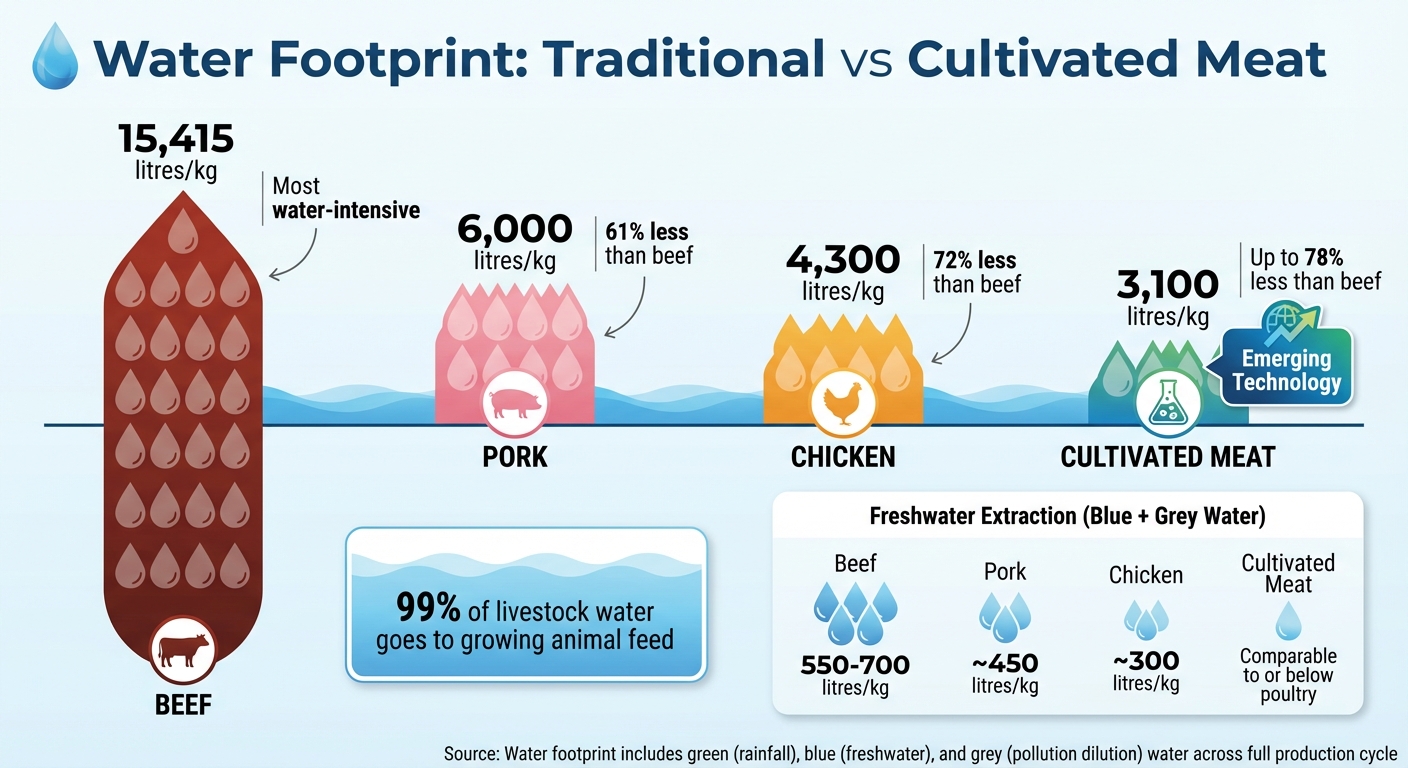
Water Usage Comparison: Traditional Meat vs Cultivated Meat Per Kilogram
Water Usage by Meat Type
When it comes to water consumption, the differences between traditional meat types are striking. Beef demands the highest water usage, followed by pork and chicken. In contrast, Cultivated Meat - while still in its developmental stages - shows potential for significantly lower water requirements, according to early projections.
The table below compares water use for various types of meat, detailing the total water footprint (which includes green, blue, and grey water) and freshwater extraction (blue and grey water only). Blue water, sourced from rivers, lakes, and aquifers, is particularly critical in areas facing water shortages, as it represents actual freshwater removal rather than rainfall-fed water. Here's how the numbers stack up:
| Meat Type | Total Water Footprint (litres/kg) | Freshwater Extraction (litres/kg) | Main Water Drivers |
|---|---|---|---|
| Beef | ~15,000 | 550–700 | Feed production, livestock drinking, housing, processing |
| Pork | ~6,000 | ~450 | Feed production, animal housing, processing |
| Chicken | ~4,300 | ~300 | Feed crops, shorter rearing cycle, efficient feed conversion |
| Cultivated Meat | ≈3,100 | Comparable to or below poultry | Nutrient medium production, bioreactor operation, facility cleaning |
This comparison makes one thing clear: traditional meats consume a substantial amount of water, whereas Cultivated Meat has the potential to use much less. By eliminating the need for animal rearing and feed cultivation - two of the most water-intensive steps in traditional meat production - Cultivated Meat offers a more resource-efficient alternative. Early lifecycle assessments suggest it could use up to 78% less water than beef, with an estimated water usage of around 3,100 litres per kilogram [1]. However, these estimates depend on the design and energy sources of future commercial facilities.
For UK consumers interested in this emerging, water-conscious option, the Cultivated Meat Shop is an excellent resource. Although these products aren't yet widely available, the platform provides educational content, previews of upcoming products, and waitlists. It’s a great way to stay informed about when and how Cultivated Meat could become a practical, water-efficient alternative to traditional meats.
What Consumers Can Do
Choosing Meats with a Smaller Water Footprint
One practical way to reduce your water footprint from meat consumption is to rethink the types of meat you eat. As mentioned earlier, beef has a significantly higher water demand compared to pork or chicken. By opting for chicken or pork more often and saving beef for occasional meals, you can make a meaningful impact.
Incorporating these changes into your meals doesn’t have to be complicated. For instance, swap your usual Sunday roast beef for a chicken roast, or use pork or turkey mince in your bolognese instead of beef mince. Planning a barbecue? Go for chicken kebabs instead of beef burgers. And when you do serve beef, try using smaller portions and pairing it with vegetables, pulses, or grains - foods that require much less water to produce [3].
Another way to make a difference is by tackling food waste. A large portion of the water used in meat production goes into growing animal feed [7]. Reducing waste not only saves money but also ensures that this embedded water isn’t squandered. Buy only what you need, freeze meat before it reaches its use-by date, and get creative with leftovers - turn them into sandwiches, pies, or stir-fries. These small changes can collectively have a big impact while complementing broader innovations in meat production.
Exploring Alternatives with Cultivated Meat Shop

If you’re keen to make a bigger change, learning about emerging alternatives like cultivated meat could be a game-changer. Cultivated meat, grown from animal cells, eliminates the most water-intensive stages of traditional meat production, such as growing feed and raising animals. With water use around 3,100 litres per kilogramme, it rivals or even outperforms poultry in terms of efficiency.
The Cultivated Meat Shop is a great resource for understanding this innovative option. It breaks down how cultivated meat is produced and shares accessible insights into its environmental benefits, including water savings. The platform also offers articles that simplify technical studies, helping consumers grasp concepts like water footprints and the impact of feed production in conventional meat farming.
Although cultivated meat products aren’t yet available in the UK, you can join the waitlist to stay updated on launch details. The site also provides recipe ideas for substituting conventional meats in popular British dishes and keeps you informed about the latest research. It’s a forward-thinking way to stay ahead of the curve as food production evolves.
Conclusion
Examining water usage in meat production highlights some striking inefficiencies. Producing a kilogramme of beef demands around 15,415 litres of water, while pork and chicken require approximately 6,000 and 4,300 litres per kilogramme, respectively. Despite animal agriculture consuming 29–40% of agricultural water, it contributes only 18% of the global calorie intake[11].
Cultivated Meat offers a radically different solution. By growing meat from animal cells in bioreactors, it sidesteps the enormous water requirements tied to raising livestock and growing their feed. Early studies suggest Cultivated Meat requires about 3,100 litres of water per kilogramme of protein - cutting water use by up to 78% compared to beef[12]. This makes it an attractive option for anyone aiming to lower their water footprint without giving up meat entirely. Such choices could play a pivotal role in reshaping our food system to be more water-conscious.
Shifting away from water-intensive meats like beef in favour of pork, chicken, or Cultivated Meat can lead to substantial water savings. For those curious about the next frontier in sustainable eating, Cultivated Meat represents a game-changing opportunity. Platforms like Cultivated Meat Shop provide guides, research updates, and waitlist options to help UK consumers stay informed as this innovation becomes more accessible. These advancements underline the pressing need to safeguard our freshwater resources.
As water scarcity becomes an ever-pressing challenge, solutions like Cultivated Meat offer a practical way to combine environmental responsibility with the foods we love. With the future of meat production evolving rapidly, staying informed ensures you're ready to embrace these changes.
FAQs
How does cultivated meat use less water than traditional meat?
Cultivated meat requires far less water compared to traditional meat production. This is because it’s developed from animal cells in controlled settings, bypassing the need for water-heavy activities like raising livestock, growing feed crops, or managing expansive farms.
By simplifying the production process, cultivated meat not only cuts down on water usage but also tackles some of the environmental issues tied to conventional meat farming. It offers a forward-thinking alternative that could help ease the strain on natural resources.
How does water usage in meat production impact the environment?
The water demands of meat production can differ significantly based on the type of meat being produced. Traditional meat, especially beef, is known for its high water consumption, which can place immense pressure on water resources and lead to environmental challenges.
On the other hand, cultivated meat is produced in controlled environments that allow for more efficient use of water. This approach typically requires far less water compared to conventional meat production.
By cutting down on water usage, cultivated meat emerges as a more resource-efficient option. This not only helps tackle water scarcity but also aligns with the growing demand for eco-friendly food choices.
Why does beef use so much more water than other types of meat?
Beef production demands considerably more water compared to other types of meat due to the resources required to raise cattle. A large portion of this water is used for growing feed, providing drinking water, and handling processing needs.
Cattle, unlike pigs or chickens, consume significantly more feed and require a longer time to reach maturity. This extended process results in much higher water consumption, making beef one of the most resource-intensive meats in terms of water usage.


