

Here’s the short answer: I can’t buy any of these products in the UK as of 10 August 2026. But I can already see where they may show up first: restaurants for steak, fillets and salmon, and shops for sausages and hybrid chicken.
In this roundup, To understand what cultivated meat is before diving in, I’m looking at 5 products:
- Aleph Cuts thin-cut beef steak
- UPSIDE Foods chicken fillet
- GOOD Meat hybrid chicken product
- Meatable pork sausages
- Wildtype salmon saku cuts
The main thing is simple: format shapes use. A thin steak or salmon saku cut suits chefs and menu service. A sausage or frozen hybrid chicken product fits home meals with less effort. Right now, the approved markets mentioned are mainly the US and Singapore, while the UK is still waiting for regulatory approval.
Quick comparison
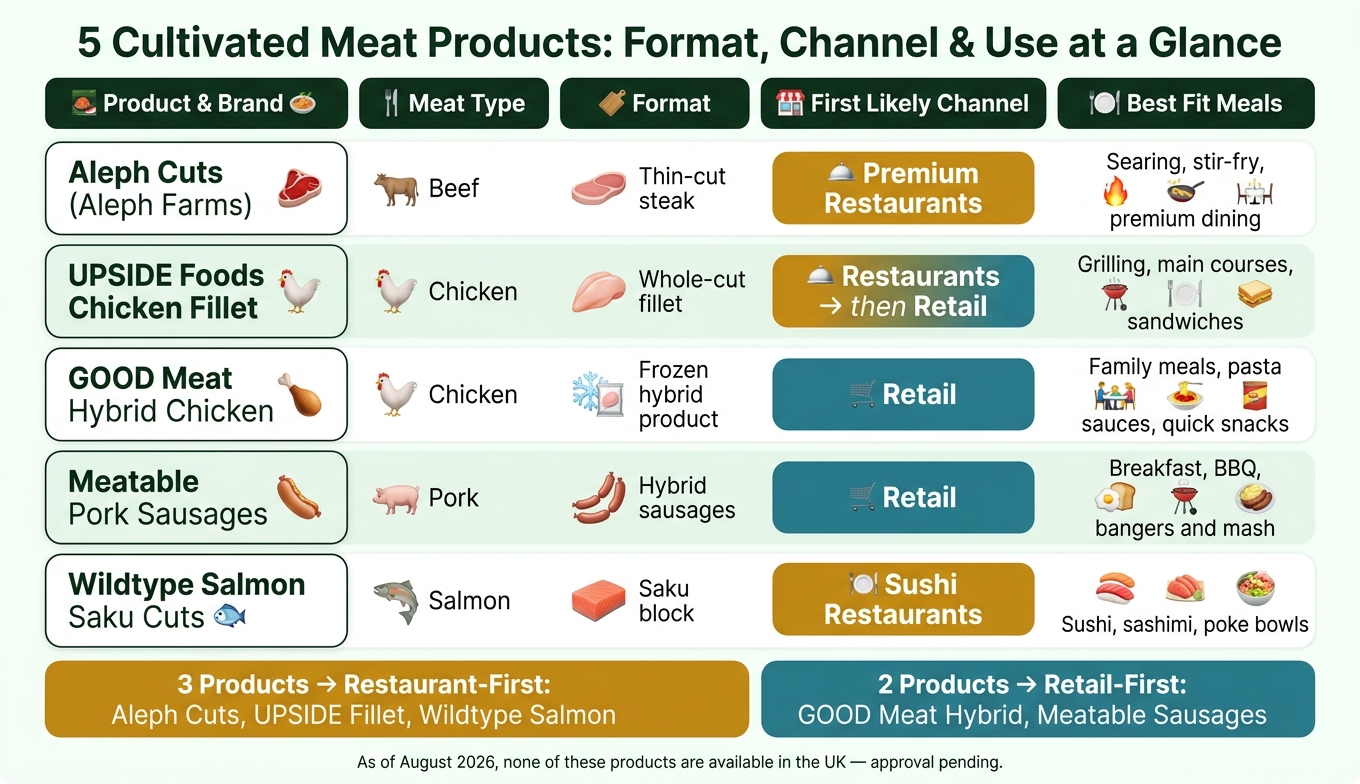
5 Cultivated Meat Products: Format, Channel & Use at a Glance
| Product | Meat type | Format | First likely route | Best fit |
|---|---|---|---|---|
| Aleph Cuts | Beef | Thin-cut steak | Restaurants | Seared dishes, small plated meals |
| UPSIDE Foods | Chicken | Whole-cut fillet | Restaurants first, then retail | Grill meals, salads, sandwiches |
| GOOD Meat | Chicken | Hybrid frozen product | Retail | Midweek meals, wraps, rice dishes |
| Meatable | Pork | Hybrid sausages | Retail | Breakfast, BBQ, bangers and mash |
| Wildtype | Salmon | Saku cut block | Restaurants | Sushi, sashimi, poke bowls |
What stands out most to me is this: 2 products look best suited to home cooking now - GOOD Meat and Meatable. The other 3 lean more towards chef-led service first. This shift represents one of the many challenges and solutions facing the industry's scale-up.
If I’m a UK shopper, that makes this less about buying today and more about knowing the cultivated meat availability timeline - and what might fit my plate when it does.
sbb-itb-c323ed3
1. Aleph Farms Aleph Cuts thin-cut beef steak
Aleph Cuts is a thin-cut Cultivated Meat beef steak made for premium restaurant dishes, sliced salads, and tasting menus. That detail matters. Early Cultivated Meat products are most likely to show up first in controlled, chef-led settings.
The format also fits a market where output is still limited. Smaller portions make more sense at this stage, and they line up with a restaurant-first launch.
That gives a pretty clear signal about how early Cultivated Meat beef is likely to reach the market. For UK shoppers, it points to a premium, restaurant-first path for early Cultivated Meat beef.
2. UPSIDE Foods cultivated chicken fillet

UPSIDE Foods has US regulatory clearance for Cultivated Meat [2]. Its chicken fillet is a whole-cut product, grown to form organised muscle and fat that closely mirrors a chicken breast [1][4].
That matters because this is the kind of product people can picture straight away on a plate. It grills, slices and plates like conventional chicken, so it fits easily into chicken burgers, salads and simple chicken dinners.
But there’s a catch: whole-cut meat is hard to make well. For that reason, this type of format is more likely to show up in restaurants first, where smaller volumes and menu-led launches make more sense.
Whole-cut formats are likely to reach restaurants before retail [2].
Next comes a hybrid chicken product designed with retail in mind.
3. GOOD Meat cultivated chicken hybrid retail product

Unlike the whole-cut products above, GOOD Meat’s hybrid chicken is made with retail in mind. It blends cultivated chicken cells with plant proteins, which makes it a better fit for supermarket shelves. The cultivated cells help give it a meat-like flavour and texture, while the frozen format works well for wraps, rice dishes and other easy midweek meals.
GOOD Meat has US clearance to sell Cultivated Meat, which supports its path from foodservice into retail.
Next is a pork product built for simple weeknight cooking.
4. Meatable cultivated pork sausages
Meatable's cultivated pork sausages feel like a natural match for UK eating habits, whether that's a full English breakfast, a sausage sandwich, a pasta dish or a barbecue.
The plan is to launch them in a hybrid format, mixing cultivated pork cells with plant-based proteins. The cultivated pork fat is there for a simple reason: it helps give the sausages the pork flavour and juicy bite people look for.
They should grill, pan-fry or bake much like standard sausages, so they can slip into day-to-day UK cooking without much fuss.
Next comes a seafood format made for slicing and serving cold, or with a light sear.
5. Wildtype cultivated salmon saku cuts
Wildtype pushes the restaurant-led seafood format one step further with a cut made for precision. Its cultivated salmon is sold as a saku cut - a rectangular block shaped for clean, exact slicing. That makes it a good fit for sashimi, nigiri, poke bowls and gravlax. It is made to match conventional salmon in both taste and texture.
In July 2025, Wildtype's cultivated salmon launched at Kann in Portland, Oregon, becoming the first cultivated seafood sold in a US restaurant. That says a lot about where the product sits today: firmly in the restaurant space for now.
This is a chef-first format at this stage. The saku cut is built for hands-on preparation, so it slots neatly into sushi counters, tasting menus and premium restaurants before moving into retail.
How these five products compare by format and use
Now that each product is on the table, the main difference comes down to format and launch channel. That matters more than it might seem at first glance. The format often decides how people cook the product and where it is sold first. And that split helps explain why some items are more likely to show up in restaurants before they land on supermarket shelves.
Here’s the quick comparison. For a deeper look at the technology behind these products, see our cultivated meat guides.
| Product | Meat Type | Format | Likely First Channel | Typical Uses |
|---|---|---|---|---|
| Aleph Cuts | Beef | Thin-cut steak | Premium restaurants | Searing, stir-fry, premium dining |
| UPSIDE Chicken Fillet | Chicken | Whole-cut fillet | Restaurants / retail | Grilling, main courses, sandwiches |
| GOOD Meat Hybrid | Chicken | Frozen hybrid chicken product | Retail | Family meals, pasta sauces, quick snacks |
| Meatable Sausages | Pork | Sausages | Retail | Breakfast, BBQ, bangers and mash |
| Wildtype Saku Cuts | Salmon | Saku blocks | Sushi restaurants | Sushi, sashimi, poke bowls |
Which products suit everyday home cooking
For home cooks, the easiest formats are usually the ones they already know how to use. That makes Meatable's pork sausages and GOOD Meat's hybrid chicken the most straightforward options for day-to-day meals.
GOOD Meat's hybrid chicken mixes Cultivated Meat with plant protein, so it fits neatly into dishes like pasta sauces, family dinners and fast midweek food. It doesn’t ask people to learn a new cooking style, as it offers identical taste and nutrition to traditional meat. It just drops into meals they already make.
Meatable's sausages follow the same pattern. Sausages are familiar, flexible and easy to picture at home, whether that’s breakfast, a BBQ or bangers and mash.
UPSIDE's chicken fillet is also a familiar shape, but it still feels more like a premium cook-at-home choice than an everyday freezer staple.
Which products are likely to appear in restaurants first
Restaurants are more likely to get the chef-led formats first. Aleph Cuts and Wildtype's saku blocks fit that pattern. They suit menus where presentation, texture and cooking method matter a lot, so they make sense as early restaurant items.
What this means for UK shoppers
For UK shoppers, these products are still ones to watch, not items you can buy today. Each one still needs UK approval before it reaches consumers. So the most useful question is pretty simple: where would it fit on an ordinary dinner plate?
That’s where this starts to click for UK readers. Sausages, chicken fillets, salmon cuts and steaks already sit comfortably in everyday cooking. They’re not abstract lab ideas. They map to meals people already make at home. However, success depends on solving taste and texture challenges to ensure they truly match the experience of conventional meat.
Cultivated Meat Shop lets readers register interest, browse previews and track approval progress. It is an educational platform, not a manufacturer. [1][3]
Matching these products to familiar UK meals
Meatable's cultivated pork sausages are the clearest fit for day-to-day British eating. Think a full English breakfast, a weekend barbecue, or bangers and mash on a Tuesday night.
GOOD Meat's hybrid chicken suits the sort of midweek meals many households lean on. Pasta sauces, quick stir-fries, and simple family dinners all make sense here.
UPSIDE Foods' chicken fillet lines up with the classic chicken breast dinner. You could grill it with vegetables, slice it into a sandwich, or serve it as the main part of an easy weeknight plate.
Aleph Farms' Aleph Cuts thin-cut beef steak is the natural match for a steak dinner.
Wildtype's salmon saku cuts point to a different sort of use in the UK: home sushi, sashimi, or a poke bowl.
Conclusion: The first cultivated meat formats are taking shape
Put side by side, these five products make two things clear. First, cultivated meat is already showing up in a wide mix of formats: steak, fillet, hybrid chicken, sausages and salmon. Second, the format matters just as much as the meat itself.
That matters in practical terms. The restaurant-first products are Aleph Farms' Aleph Cuts and Wildtype's salmon saku. These high-end formats require solving consistency issues to meet chef standards. On the retail side, Meatable's sausages and GOOD Meat's hybrid chicken make more sense, where familiar formats and simple cooking tend to matter most.
There’s also a clear retail angle with hybrid products that blend cultivated fat with plant proteins. They may be easier to scale and easier to price for shop shelves.
For UK shoppers, the main point is straightforward: none of these products is available in the UK yet. However, the global industry momentum suggests this could change as international markets mature. Cultivated Meat Shop tracks UK approval progress and product updates.
FAQs
When will these products reach the UK?
Cultivated Meat products are still moving through the UK approval process under the Food Standards Agency’s regulatory sandbox. If everything stays on schedule, products for human consumption are expected to reach the market by March 2027.
At first, they’ll most likely show up in a small number of restaurants rather than on every high street menu. After that, UK supermarket distribution is projected to follow by 2027.
For launch updates and waitlists, visit Cultivated Meat Shop.
Why are some cultivated meat products launching in restaurants first?
Some cultivated meat products are launching in restaurants first. That lets companies keep production runs small and controlled while they learn how people respond and how day-to-day service works in practice.
It’s a step-by-step rollout. Manufacturers can fine-tune the product, earn confidence from early adopters, and help people get used to the idea before aiming for broader retail distribution.
Which of these products are easiest to cook at home?
Processed Cultivated Meat formats such as nuggets, burgers, sausages and mince will probably be the simplest options to cook at home.
They’re also likely to be among the first products on sale. That makes sense: they fit cooking methods people already use, like grilling, pan-frying and baking. In practice, that means they should slip into favourite meals without much fuss.


